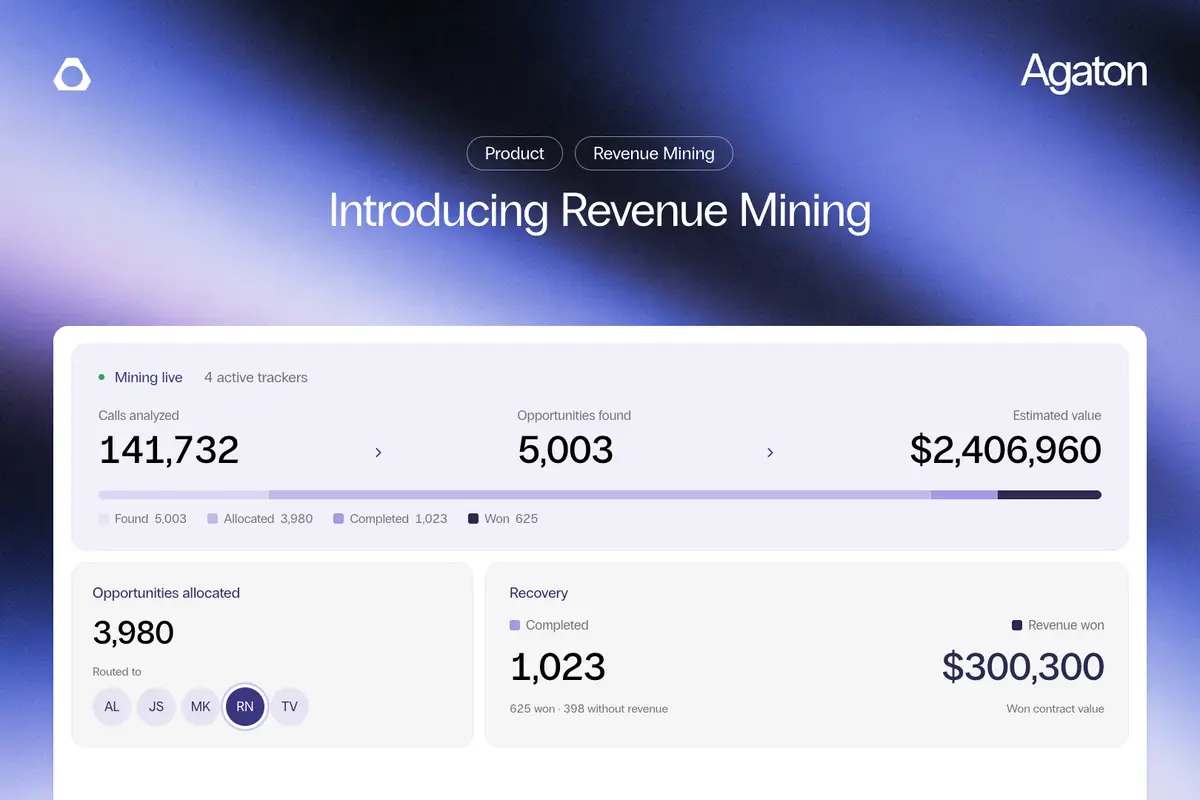
Voice is where enterprises sell, serve and keep their customers, and AI is changing what that data is worth. Deciding how to turn your conversations into measurable revenue has become a defining call for leadership teams. This guide sets out the trade-offs between working with a specialist deep voice AI platform and building the capability in-house, so you can start capturing commercial value sooner and with less risk.
TL;DR: Quick summary
- Core focus vs. platform build: An internal build ties up your strongest engineers on infrastructure instead of your core product roadmap.
- Precision determines adoption: Speech intelligence is not just transcription. Capturing nuances like tone and hesitation while eliminating noise requires sustained, specialized domain evaluation.
- Time to value: Agaton deploys in weeks with embedded forward-deployed engineers, skipping months of prototyping and model maintenance so you capture lost revenue immediately.
Unlocking the hidden value in conversational data
Organizations in telecommunications, financial services, and customer care handle millions of minutes of conversation every month. According to market analysts, voice remains the highest-converting and most nuanced channel in enterprise operations.
From a commercial perspective, this call volume is an untapped source of customer signals: hidden churn risks, missed upsell cues and unanswered objections. But without the infrastructure to extract and categorize these insights, raw call audio quickly becomes a storage burden rather than something your teams can act on.
The technical complexity: from prototype to production
Building a prototype on clean audio in a sandboxed environment is relatively straightforward. Operating an enterprise pipeline at scale is not.
In production environments, models must process:
- Suboptimal call conditions (packet loss, heavy background chatter, and low-bitrate codecs).
- Continuous speaker diarization and real-time PII redaction to satisfy strict GDPR and security standards.
- Regional accents, vernacular shifts, and bilingual switching mid-sentence.
A sandbox system only needs to succeed under controlled conditions. An enterprise tool must deliver high precision across millions of interactions, every day.
Why text transcription is not enough
Most standard conversational analytics tools evaluate transcripts alone. However, transcripts only reflect the literal words spoken; they omit acoustic inflection, pace, and hesitation. These are the dimensions where commercial intent actually sits.
Consider a prospective customer replying: "Yes, that sounds fine."
Text analysis flags this as a positive buying signal. To acoustic analysis, a flat, trailing pitch reveals hesitation and churn risk.
Agaton combines lexical intelligence (what is said) with prosodic modeling (how it is said). Rooted in over six years of academic speech-science research and trained on more than 10 million enterprise interactions, our platform isolates subtle cues without triggering the false positives that erode operational trust.
The hidden costs: evaluation, model churn, and maintenance
A standard internal build budget typically accounts for raw infrastructure and model token fees. The ongoing operational overhead, however, is significantly higher:
- Systematic evaluation frameworks: When an internal team alters a prompt or swaps a foundational model, evaluating whether precision improved or degraded across varied product lines is an entire discipline.
- Model lifecycle management: Foundational models shift rapidly. Auditing latency changes, price points, and API deprecations requires persistent developer hours.
- The cost of low precision: Trust in internal tools is asymmetrical. If a system delivers 100 alerts and only five prove actionable, operational leads and frontline agents abandon the platform.
Dedicated engineering: partner vs. in-house
Financial, telco, and enterprise organizations operate via specialized divisions. Just as financial institutions partner with dedicated open banking platforms to process transactions rather than building core connectivity from scratch, high-performing sales and customer care teams partner for sales intelligence.
At Agaton, our dedicated focus is deep voice AI and audio ML pipelines. Rather than diverting internal developers away from your core customer-facing products, partnering gives you immediate access to mature platforms, hardened data privacy frameworks, and specialized domain expertise.
When does an in-house build make sense?
Building an internal solution is viable if sales intelligence is your primary commercial offering. For other organizations, this intelligence supports the core business. It is not the business itself. The strategic question is not whether your engineering team can assemble a pipeline, but whether that allocation delivers the highest possible commercial return on their time.
Five questions every leadership team should ask
- Evaluation: How will we objectively verify whether an update made our insight engine more accurate across distinct product lines?
- Operational ownership: Who is on call when an ingestion or processing pipeline fails during peak hours?
- Talent continuity: What happens to the bespoke codebase when the primary architect moves on?
- Opportunity cost: Which core products and features are deprioritized while engineers maintain this tool?
- Adoption: How will we guarantee that hundreds of frontline agents trust and act on these insights every week?
Go live in weeks, not quarters
An internal build often requires several quarters to reach a stable state, leaving potential revenue uncaptured.
Agaton deploys in weeks. Every deployment pairs your team with a forward-deployed engineer who maps data directly to your operational KPIs, manages integrations, and fine-tunes models to your specific commercial workflows.
Evaluate your roadmap
Unsure which architecture best matches your technical roadmap? Book a 30-minute review with one of our forward-deployed engineers. We will run through your current stack, assess the five questions above, and provide an objective evaluation of the trade-offs between building and partnering.