Somewhere in your call recordings right now, a customer is telling you they want to buy. They're just not saying it in words.
It's the half-second of dead air after you ask them to commit to a next step. The drop in energy the instant price comes up. A cheerful "yeah, sounds great" that, if you actually listened to it instead of reading it, would sound like someone stalling for time. None of that survives speech-to-text. All of it survives in the audio, sitting untouched in calls you've already recorded.
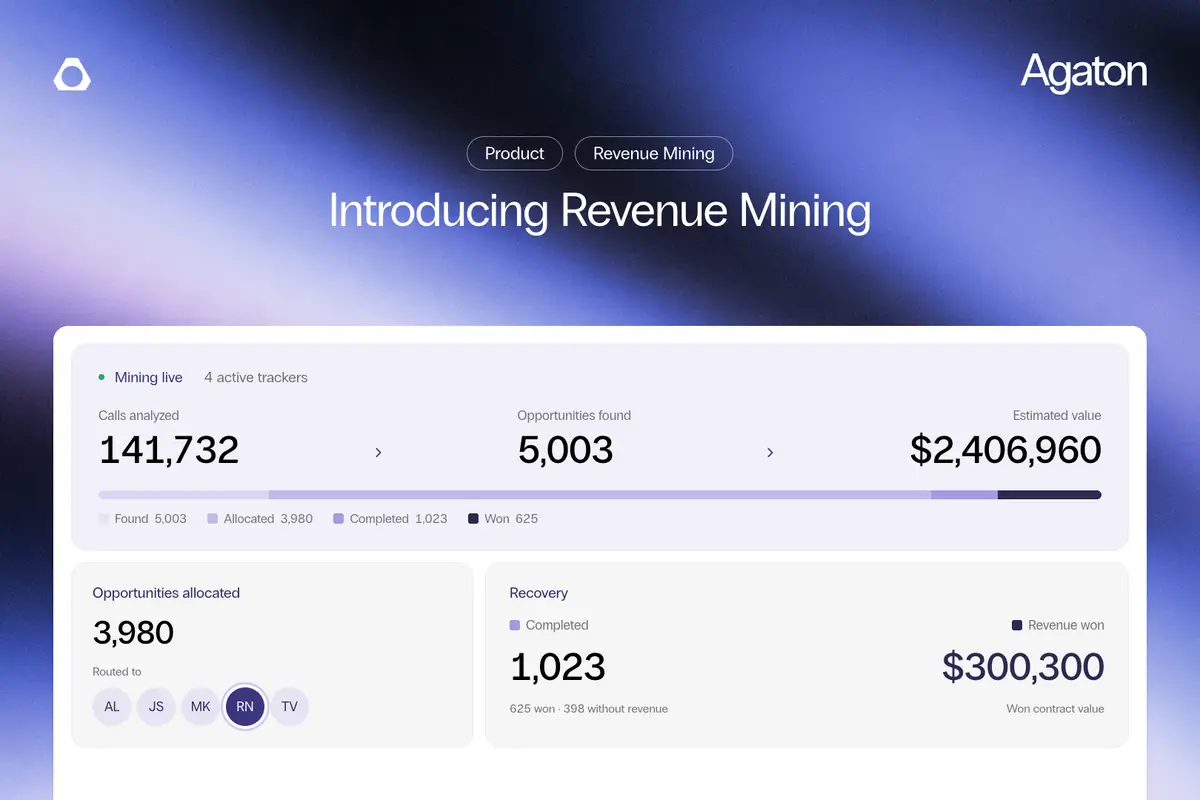
That's the gap our sales intelligence engine was built to close. It's the engine behind revenue mining: systematically finding missed opportunities in past conversations and generating concrete next steps to close them.
Why transcript-only tools miss it
Most conversation-intelligence tools run the same pipeline: audio → speech-to-text → text analysis → insights. It's a reasonable shortcut. Text is cheap to store, easy to search, and simple to build a UI around. The problem is that transcription is lossy in exactly the direction that matters. It keeps the words and drops the delivery: response latency, pitch and speech-rate changes, interruption patterns, talk-to-listen shifts, and any hesitation that positive language happens to be masking.
Two customers can say the identical sentence, "yeah, that sounds great," and mean opposite things. One says it quickly, upbeat, ready to move. The other says it after a pause, flat, already halfway to a reason to delay. A transcript can't tell them apart. It sees the same six words twice.
The signals we treat as data
Prosody — pitch contours, speech-rate changes, and the micro-pauses right before a commitment. Agreement that arrives instantly and agreement that arrives after a beat of silence are not the same signal, even when the words match.
Voice quality — shifts in loudness, vocal tension, and timbre. A rep will often see a deal look healthy on paper right up until a call where energy visibly drops the moment price is mentioned, and nothing in the notes will say why.
Timing and interaction — silence after pricing questions, latency before responding to next-step proposals, interruption frequency, talk-to-listen ratio. Individually these are noisy. In sequence, they tell a story: pricing question, long latency, reduced energy, short affirmation, abrupt topic change. That sequence is a pattern worth flagging on its own.
Mismatch — positive words paired with hesitant delivery. This is usually where the highest-value signal lives, because it's the one thing a transcript is structurally incapable of seeing.
Why this was hard to build
The honest engineering challenge is that multimodal models love to cheat. When text and audio are both available, a model trained naively will often learn to ignore the audio almost entirely, because text alone already explains most of the outcome and gradient descent takes the cheapest path to a low loss. Getting a model to actually use the acoustic channel means deliberately training on the cases where text and voice disagree, the "yeah, sounds great" said with dread, so the model can't get away with reading words alone. That disagreement is exactly the signal we care about, so we had to make sure training didn't optimize it away.
That's also why context matters as much as the raw signal. A long pause during discovery might just mean someone is thinking. The same pause right after you name a price means something else entirely. Our engine is built to know the difference, weighing acoustic evidence differently depending on where in the conversation it shows up rather than applying one fixed rule everywhere.
One clarification, since this is the point people usually ask about: this measures outcomes, not emotions. It's trained to predict whether a deal is moving forward or stalling, not to diagnose how someone feels.
Revenue mining, in action
This is what revenue mining runs on. Every call is scored for undetected interest, hidden objections, at-risk commitments, and buying signals that never made it into the CRM. For each one flagged, the system generates a plain-language explanation of what it saw, a recommended outreach angle, and a suggested talk track built for that specific conversation.
Take a deal that had gone quiet. It sat marked "no decision" for weeks, effectively written off. But on the last recorded call, the buyer's voice had lit up the moment implementation timelines came up, and they'd leaned in hard around one specific feature, even though the word "yes" never actually came out of their mouth.
Instead of a generic check-in email, the system surfaced that moment and suggested something sharper: reference that feature by name, and offer a focused implementation walkthrough instead of a status update. The rep sent it. A technical session got booked within the week. The deal moved back into active negotiation, not because anyone worked harder, but because the signal that mattered had finally been heard.
Detect. Explain. Act. Close.
Every customer call your company makes is already being recorded. The advantage was never going to come from recording more of them. It comes from building the intelligence layer that can actually pull the signal out of what you already have, and turn it into action at scale, so nothing meaningful in your conversations goes unused.