At Agaton, our work in coaching, quality assurance and sales enablement has taught us something that shaped how we built Revenue Mining: people improve, but even excellent people cannot capture every opportunity.
A customer-service agent can resolve an issue perfectly and still miss a need that belongs to another department. A seller can handle an objection well without recognizing the significance of a passing comment. Sometimes the signal is subtle. Sometimes it is simply 5 PM on a Thursday.
Expecting everyone to recognize, remember and act on every commercially relevant detail is an unrealistic requirement. We built Revenue Mining to put a system around that limitation: one that discovers opportunities in customer interactions, helps the organization act on them and learns from the outcome.
The opportunity has to survive the interaction
Consider a customer who calls about a billing issue and mentions that their business is opening two new locations. The agent resolves the bill. The customer leaves satisfied. The expansion may be relevant to another team, but it never becomes an opportunity in the CRM.
Catching the mention is only the first step. The organization still needs to establish whether there is a relevant need, who should follow up and what that person needs to know. A useful system has to carry the opportunity through those steps.
That requirement defines Revenue Mining. Its value depends on the connection between discovery, qualification and action, and on whether the result informs what happens next.
From discovery to a qualified next step
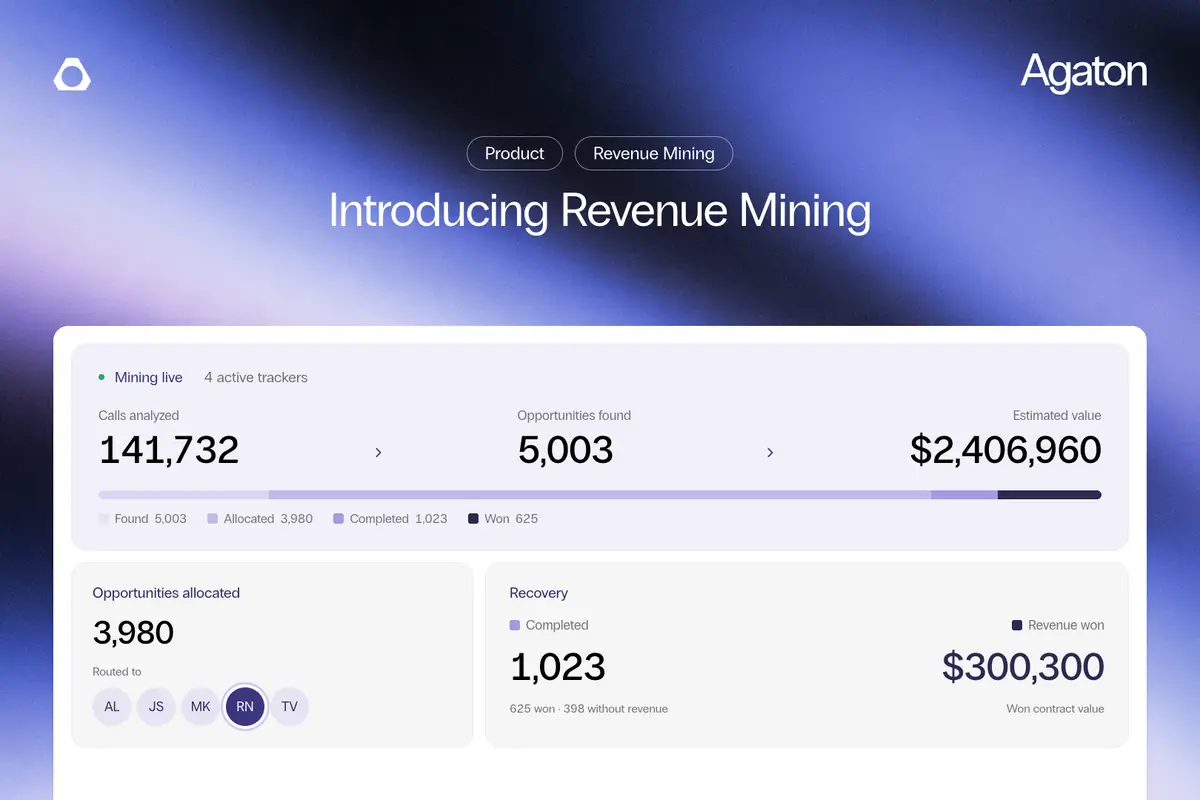
Revenue Mining begins by exploring customer interactions alongside business context and outcomes. Agaton's agent swarm looks for signals and patterns that suggest where revenue is being left on the table, including opportunities the business has not explicitly told the system to search for. Discovery matters because a company cannot define every useful question in advance.
The system then interprets the signal in context. What does the customer appear to need? How does that fit with the existing relationship and the information available in CRM and other operational systems? A mention of expansion is a reason to investigate; it does not, by itself, establish buying intent.
Where appropriate, the customer can be contacted to explore the need and validate interest before an opportunity is passed onward. This gives the receiving team something more useful than a sentence extracted from a call: an opportunity with context and an understood reason to follow up.
Agaton assigns the opportunity to the person best positioned to act, considering the product, market, customer relationship and type of need. It also matches the customer with the seller who is strongest in the techniques best suited to that specific customer. The seller receives the relevant context and guidance on how to approach that particular conversation, informed by what has worked before.
In the expansion example, that means connecting the original comment to a validated need, a suitable owner and a relevant approach. Each step makes the next one possible.
Understanding how something was said
The quality of those decisions depends on how well the interaction is understood. A transcript captures the words, but some of the meaning is carried in the voice.
"Yeah, that sounds great" can express enthusiasm, uncertainty or sarcasm. Treating each version as the same buying signal loses information that matters to the next action.
Agaton analyzes vocal signals alongside the words, including tone, pace, hesitation and signs of frustration or confidence. These signals help interpret the exchange in context. A pause or a change in tone is evidence to consider, rather than a conclusion on its own.
The same analysis applies to the seller. When an objection appeared, did they slow down, ask another question or explain the product differently? How did the customer respond? Connecting those behaviors with outcomes helps identify approaches worth learning from and sharing.
Learning across human and AI interactions
Revenue Mining draws on customer interactions with both people and AI agents, combined with CRM data and other operational context. It connects what the customer needed with the action taken and the resulting outcome. Voice adds information where audio is available; the broader learning process extends beyond phone calls.
Once an opportunity has been qualified, assigned and acted on, the outcome is connected back to the original interaction. Did the customer buy? Did they decline? Did a customer showing signs of leaving stay? Which approaches were associated with better results?
That feedback helps the system learn which signals are useful and which actions are worth repeating. It also makes unsuccessful follow-ups informative: a promising signal that repeatedly leads nowhere should affect the next decision.
For the organization using Revenue Mining, this connection shows which opportunities turn into revenue and which actions help retain customers. Teams can use those results to focus on the signals and approaches that work. Experience that would otherwise remain inside one seller, team or market becomes available across the organization.
Revenue growth includes keeping customers
Cross-sell, upsell and missed buying signals are natural applications. The same process also supports retention. A customer expressing frustration or considering another provider may need a service intervention before any commercial conversation makes sense. Understanding the need changes both the action and who should take it.
Across many interactions, Revenue Mining can also reveal unmet needs and show where particular products resonate. These patterns matter when a company launches a product or enters a new market, when teams are still learning which needs, objections and approaches deserve attention.
Connecting customer responses to subsequent outcomes gives those teams a shared basis for adapting. Lessons from individual interactions become available to the wider organization, and the next decision can draw on more than one person's experience.
Building around the people doing the work
Revenue Mining grew out of seeing what coaching and enablement can achieve, and where the organization needs additional support. People still need to solve the problem in front of them and make good decisions in the moment. The system helps commercially relevant signals survive beyond that moment and reach someone who can act.
The practical starting point is an interaction your organization already has. When a customer reveals a need, can you follow it from the first signal to a qualified action and a known outcome? That is the connection we built Revenue Mining to make.