A customer calls her auto insurer to change the address on her car insurance policy. The agent asks for the new one. She reads it out, apologizes for the noise in the background, and says they close next Friday, so she's trying to get everything moved over before then. The agent updates the record and closes the ticket. By every measure the contact center tracks, the call was a success.
It was also the moment the insurer lost a home policy it had every right to win. Nobody did anything wrong. The customer never mentioned home insurance, and the agent had a queue waiting. But "we close next Friday" means she's buying a house, needs cover within days, and already trusts this company with her car.
What a transcript cannot tell you
I made that call up, but I've heard versions of it more times than I can count. I spent most of my career running inside sales and customer service organizations, and a significant part of the job was listening to calls. People tell you things they did not call to tell you, and even more without saying it outright. A transcript can tell you what someone said. It cannot tell you what they meant. What bothered me was how routine the loss of potential revenue was.
Sales is the last black box in business
Selling is as old as trade itself, and one of the least examined things we do. Medicine built rigorous training and peer review. Law built certification. Sport became a science. Sales stayed a black box - everyone knows it works, but nobody can say exactly why, so the biggest decisions still get made on instinct.
Why opening the box matters
Opening that box helps the customer since it changes what the interaction is like for the person calling in. If a company understands what came up in your last conversation, you shouldn’t have to explain it all again. There may be no reason for anyone to follow up. But if there is, the person calling should know what you need and why they’re calling. That's the opposite of AI-generated spam and scripted pitches, the kind that made people hate sales calls in the first place. Open the black box, and you can make fewer calls, each one more relevant.
It also changes how a company understands its own customers. Every business tries to work out what people want from the outside, through surveys, panels and research. But customers are already saying it out loud on calls that happen every day. Opening the black box means the market stops being something you have to go out and research and becomes something you can hear for yourself. You can act on what people actually said instead of guessing.
And it changes growth itself. Selling more to a customer you already have costs a fraction of winning a new one, and a customer who stays longer is worth more; the economics here aren't controversial. What's missed is that most growth plans start with acquiring new demand and almost none with the demand a company has already earned and simply isn't hearing. Every missed buying signal is revenue left on the table. Every signal caught and acted on is retention, because the right product reaches the right customer at the right time. And once a company can hear its customers at scale, it doesn't just sell smarter - it starts building differently too: the products, offers and campaigns that follow are shaped by what customers actually asked for, not by what a roadmap assumed.
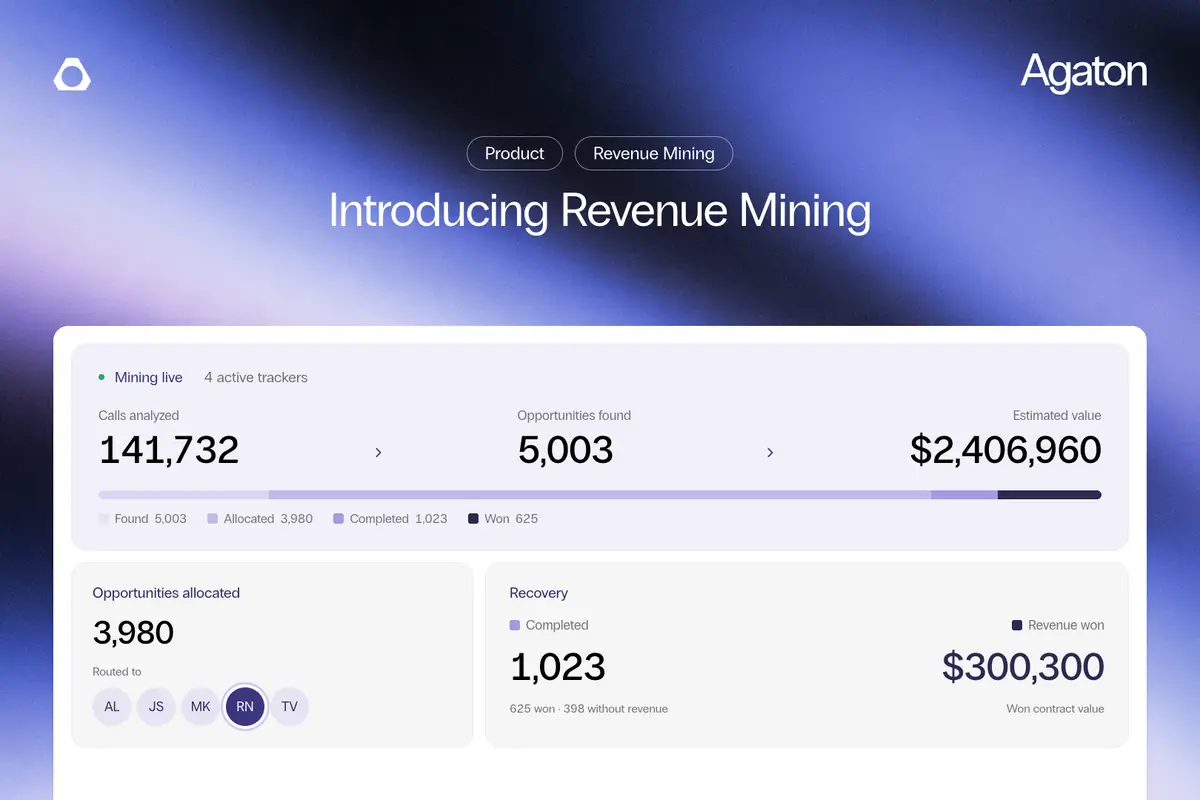
We call this discipline Revenue Mining, and it’s the clearest expression of what becomes possible when we open the black box.
How Agaton finds the right follow-up
Agaton listens to eligible calls, connects them with customer context, and surfaces the signals worth acting on. Instead of another dashboard, it delivers a short, prioritized list: who the customer is, what was said, why it matters now, and the next step to take.
The signal cuts both ways. Sometimes it's a house closing on Friday, and the follow-up is a sale. Sometimes it's a competitor's name, or a pause before "no, everything's fine," and the follow-up is the call that keeps a customer. Agaton listens for both: more revenue from existing customers, and fewer of them walking away.
We do not claim to read minds, and having led service teams myself, I would not build something that turns agents into salespeople. Agaton works in the background and routes the evidence to the right specialist, inside the company's own contact rules. When a customer tells you something, even sideways, they've handed you a piece of trust the company has already paid dearly to earn. It has to reach someone who can act while the moment is still alive.
We’ve lived it
We analyze not just what's said in a sales conversation, but how it's said - tone, hesitation, emphasis - across every eligible call, not a sample of them.
This isn't theoretical for us. Before Agaton, I built and led big sales operations at EF, one of the world's largest education companies. My cofounder and I then spent six years developing the language models behind Agaton, testing them against exactly the kind of calls I used to manage.
None of that matters if it stays a model score. So the engine is built to turn intelligence into action: a short, prioritized list a real person can work from, not a report that sits unread.
Judge us on your numbers
We've now analyzed more than ten million calls and meetings. Before a pilot begins, we agree on a baseline, what counts as incremental, and what success looks like. Then we measure actual sales or retention outcomes, cost of follow-up included. If the uplift is there, we can prove it. If it isn't, we'll both know.
Go back to the insurer. The agent hears the exact moment she says they close next Friday, knows why this customer and why now, and calls before then. She has the right protection before she picks up the keys.
Sales was the last black box in business. We built the intelligence to open the black box of sales, so companies can see what drives growth and turn it into revenue.